3 ways an autonomous coding agent can hurt you, and how to catch and block them
The most common mistake I see in conversations about AI coding agents is treating them as a code-quality problem.
That is too narrow. Bad code matters, obviously. But the sharper risk is that an autonomous agent can perform unsafe actions before anyone reviews the code changes.
Once the harness can use shell, file, and network tools, the risk shifts from "will it generate ugly code?" to "what can it do while trying to be helpful?"
Three failure modes matter enough that every engineering leader should have an opinion on them now.
1. Secret exposure
This is one of the biggest problems.
An agent is debugging. It wants context. It searches environment variables, config files, local state, and command output. During that process, secrets can be read and unknowingly exposed.
That could be:
- a secret echoed into terminal output
- a token written to a debug file
- credentials copied into a tracked file by mistake
- sensitive values included in a prompt or pasted into a note
How to catch it
You need session-level visibility into the actual commands, file writes, and surrounding context. Looking at the final diff is too late and too narrow.
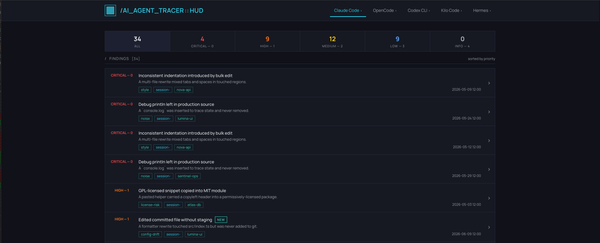
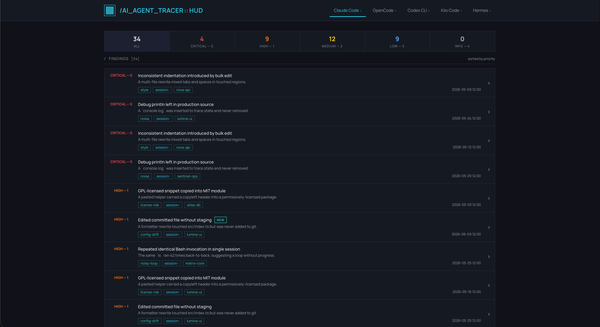
Tracer's role in this pattern is audit:
- retain the session trail
- surface suspicious command and write patterns
- make the event reviewable after the fact
If a secret-like exposure happened, the right governance layer should help you find it quickly.
How to block it
Audit is half the story.
Guardrails is the prevention layer. This is where hooks matter. If a command pattern or file target crosses a rule boundary, the harness should stop before the action runs.
That is the difference between exposure detection and exposure prevention, which is much more useful.
2. Destructive filesystem or shell operations
The classic example is an unscoped rm -rf (recently there are more and more reports than new GPT-5.6 Sol has tendecy for destructive commands like this), but it is broader than that.
The real issue is that agents often respond to failure by broadening their actions.
Humans do this too, but humans usually pause when they realize they are about to issue a dangerous command. Agents are more likely to continue the loop unless the harness forces a stop.
How to catch it
Again, you need the execution trail:
- What was attempted first
- What failed
- What broader command came next
- Which paths were targeted
- Whether the pattern appears repeatedly across sessions
That is why retrospective review still matters even if you have some prevention in place. You want to learn where risky behavior is emerging before it becomes routine.
How to block it
This is one of the clearest cases for policy hooks.
Some commands should require explicit human confirmation. Some should be denied outright outside tightly controlled scopes. Some should be rewritten into safer alternatives or run only in read-only mode.
The point is not to make the agent powerless. The point is to prevent dangerous and destructive command execution.
If the agent needs elevated capability, make that decision visible and intentional.
3. Prompt injection through fetched or inherited content
This is the one many teams still underestimate.
An agent fetches a web page, reads an issue, opens generated documentation, or consumes content from some external source. That content contains instructions. The model treats those instructions as relevant context. The agent follows them.
The attack surface is now everything the agent reads, not just the prompt the user typed.
How to catch it
You need to know:
- What external content entered the session
- When it entered
- What action followed it
- Whether the resulting behavior diverged from the user's actual objective
This is not always trivial, but it is impossible if the session trail disappears the moment the work is done.
Tracer helps here by making the sequence reconstructable. You cannot reason about prompt injection after the fact if you did not retain the chain of events that preceded the action.
How to block it
This is where guardrails need to be policy-aware rather than purely reactive.
Potential patterns include:
- Refusing human confirmation for Websearch and Fetch tools
- Requiring human confirmation for high-risk tool calls after network reads
The exact policy depends on the harness and the environment, but the general rule is simple: untrusted context should reduce the agent's authority, not silently expand it.
The important distinction: see versus stop
Serious governance needs the full loop:
- Visibility
- Detection
- Prevention
- Follow-up remediation
Why this matters now
The adoption curve for AI coding agents is running ahead of the governance curve.
Teams are already giving these tools real capability because the delivery upside is real. That is rational.
What is not rational is pretending that PR review and general engineering caution are enough to manage the new risk surface. They are not.
The work now is to treat agent activity as operational behavior that deserves controls.
The practical takeaway
If your team is already using autonomous coding agents, check whether you can do all three of these things today:
- Reconstruct a risky session after the fact
- Identify repeated patterns across sessions
- Block dangerous actions before they execute
If any of those answers is no, that is the real gap to work on.
We help teams close it with a self-hosted review and deployment model: Tracer to surface the risky behavior, Guardrails to stop the dangerous calls, and senior engineering support to interpret the findings and fix what they reveal. If you want to see the shape of the problem, start with the live demo. If you want to know where your own environment is exposed, book a call with us to get started.