What your AI coding agent actually did today
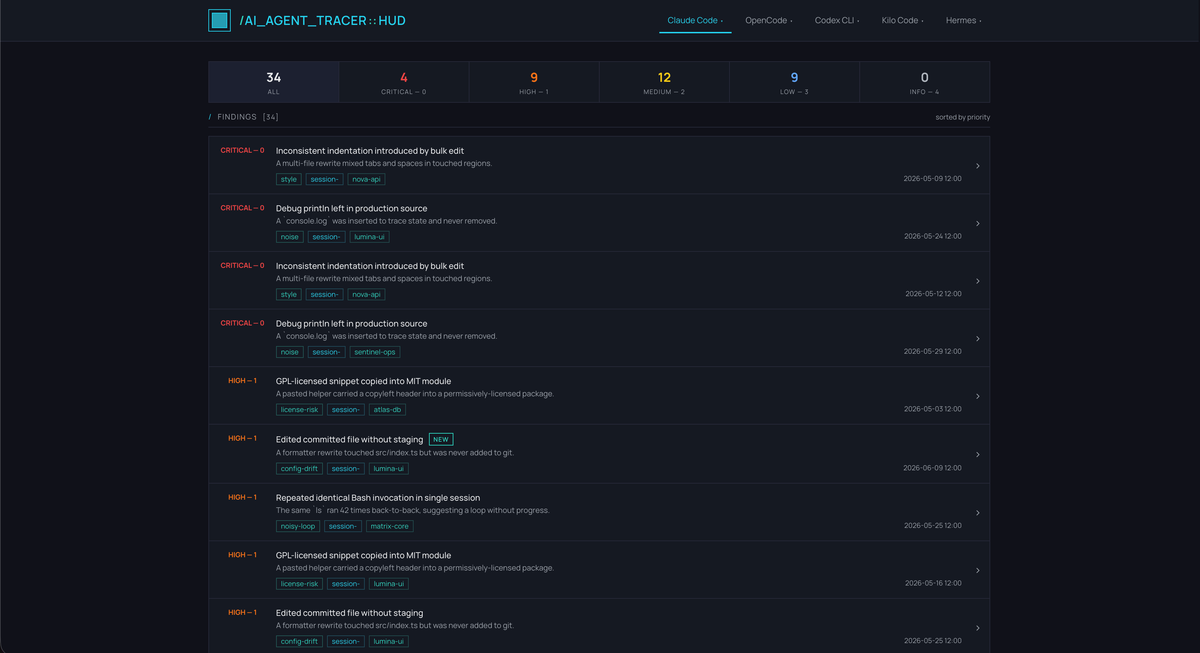
Most teams adopting AI coding agents still govern them as if they were autocomplete.
That is the first mistake.
Autocomplete suggests text. An agent runs tools. It reads files, edits files, executes shell commands, fetches remote content, retries failed operations, writes debug output, and keeps going when a human would usually stop and think. By the time you review the pull request, the interesting part has already happened.
You see the final diff. You do not see the path the agent took to get there.
That path matters.
The PR is the receipt, not the transaction
If a developer opens a pull request with a sensible set of code changes, most teams feel comfortable. The code looks coherent. Tests pass. The branch is small enough. Nothing appears obviously wrong.
But an AI coding agent can produce a clean PR after a messy session.
It might:
- search the repository far more broadly than a human would
- fetch documentation from the public web and treat it as trusted input
- dump environment variables into a temporary file while debugging
- retry a command with wider permissions after the first attempt fails
- generate or modify files that never make it into the final commit
- burn through a large context window and several expensive model calls before arriving at the same answer a human would have reached directly
None of that is visible in a normal code review.
This is why I keep saying that agent governance cannot stop at the repository boundary. The repository contains the result. The risk lives in the execution trail.
A synthetic session log is enough to make the point
Take a simple task: update a dependency, patch a config issue, and get the test suite green.
In a pull request, that might look like four changed files and a short summary.
In the underlying session, the timeline can look more like this:
- The agent scans a dozen files to infer project structure.
- It runs the test suite and gets a failure.
- It opens the failing config.
- It searches for related environment variables.
- It prints shell output containing more context than anyone intended to expose.
- It fetches external docs.
- It retries a command with broader scope.
- It edits three files that are later overwritten.
- It runs tests again.
- It produces a final patch that looks completely reasonable.
From a delivery perspective, this is normal agent behavior.
From a governance perspective, it is a blind spot.
The important question is not just "did the code end up correct?"
It is also:
- what did the agent read?
- what did it write?
- what commands did it execute?
- what external content influenced it?
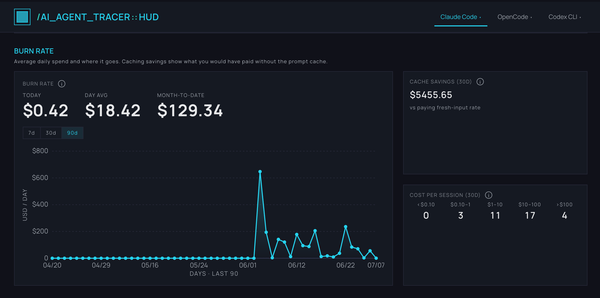
- what did it cost?
- what should have been blocked?
If you cannot answer those questions, you do not really know what happened in your own environment.
The attack surface is the full toolchain
Once an agent can use shell, network, and file tools, the attack surface expands from source code to the whole working context around the source code.
That includes:
- secrets available in environment variables
- local configuration files
- transient debug output
- generated artifacts
- fetched pages and issue threads
- package managers
- test fixtures
- deployment scripts
A human engineer can misuse those too, obviously. The difference is speed and volume. Agents perform many more intermediate actions than a human would, and teams rarely inspect them with the same discipline they apply to commits, CI, or production logs.
So the governance gap grows quietly.
Why we built Tracer
We built Tracer because this is the gap we kept seeing in teams adopting AI coding agents: the tools were already inside real delivery workflows, but the governance model had not caught up.
The productivity upside was obvious. The control surface was not.
Teams knew the agent was helping ship code.
They did not know:
- which tools it invoked most often
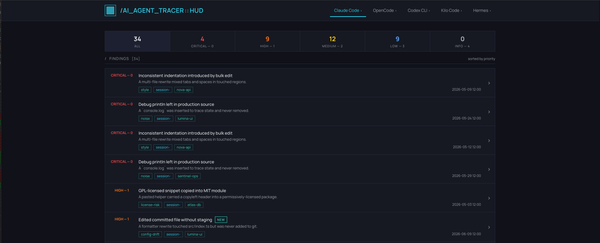
- where risky command patterns showed up
- whether prompts from fetched content were entering the workflow
- which projects were consuming the spend
- how much activity was happening outside what a PR would ever reveal
That is not a minor reporting problem. It is an operating blind spot. If you cannot reconstruct what the agent did, you cannot meaningfully govern security, cost, or delivery risk around it.
So we built the missing layer: capture the timeline, inspect it, surface the findings, and make the session reviewable after the fact.
That is the core idea.
A coding agent session should be observable in the same way any other meaningful production system is observable.
That is where Techtoria fits. We do not just point at the blind spot. We help teams instrument it, read what the data is saying, and put the right controls around it so agent adoption can keep moving without becoming an unmanaged liability.
What good looks like
For me, a governed agent workflow has four properties.
First, you can reconstruct a session. Not just the final code, but the sequence of actions that produced it.
Second, you can flag risk patterns. Secrets written to files, destructive commands, prompt-injection shaped inputs, and similar events should not require manual archaeology.
Third, you can attribute cost. If a team is spending real money on model calls, that spend needs to be visible by harness, project, and model.
Fourth, you can move from visibility to control. Seeing the problem is necessary. It is not sufficient.
That last point matters. Audit without prevention becomes an expensive way to learn the same lesson twice.
The practical takeaway
If your team is already using AI coding agents, do one simple exercise this week:
Pick one session that produced a harmless-looking PR and try to answer, from evidence, what the agent actually did between the prompt and the diff.
Not what you assume it did.
What it actually did.
For most teams, that exercise reveals the gap immediately.
The issue is rarely dramatic on day one. It is usually more mundane than that. Missing visibility. No retained trail. No policy around dangerous tool calls. No sense of which costs are accumulating where.
That is exactly how governance problems begin. Quietly, then all at once.
We help teams close that gap with a self-hosted risk review: we instrument the environment, trace what the agents are doing, surface the security and cost findings, and show where prevention needs to sit. If you want to see the shape of the problem first, start with the live demo. If you want to know what is happening in your own setup, book an AI-agent risk review with us.
Check out our demo.